Flow of an order
Rather than creating executable on-chain transactions, CoW Protocol users submit their orders as signed intent to trade messages. This allows solvers to find the optimal execution path for the batch of orders before committing them on-chain.
Let's bring all of our main concepts together by taking a look at the flow of an order through CoW Protocol.
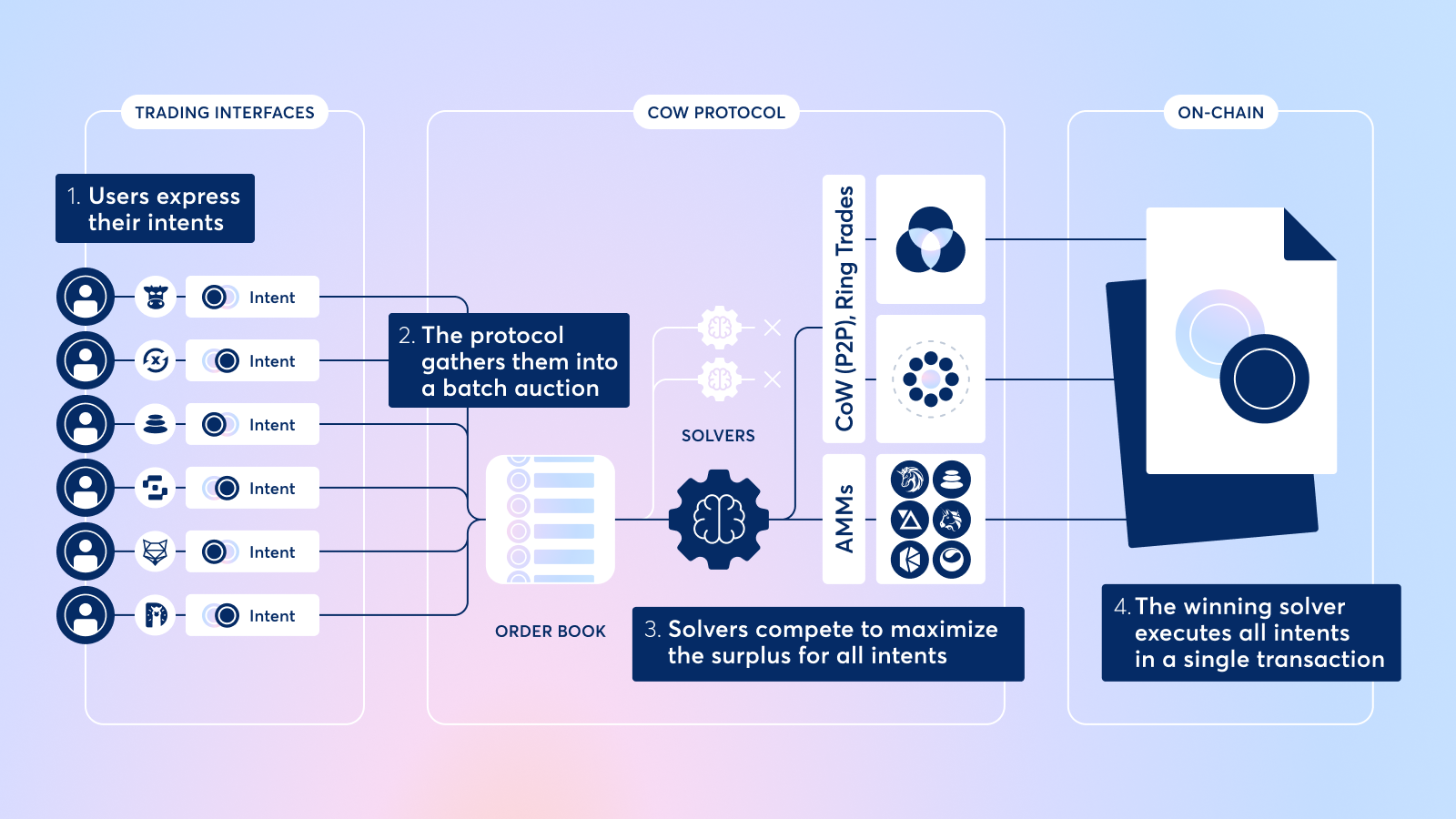
There are 4 main steps to an order on CoW Protocol:
- Users express their trade intents by signing messages that specify the assets and amounts they want to trade, alongside other parameters.
- The protocol gathers the intents of multiple users into a fair combinatorial batch auction.
- Solvers have a set amount of time to propose settlements for the batch. The solvers that are able to generate the highest amount of surplus per token pair are declared the winners.
- The winning solvers submit the (batched) transactions on-chain on behalf of the users.
Once each winning solver executes the orders for which they proposed the best bids on-chain, users receive their tokens.
The competition between solvers in a fair combinatorial auction ensures that users (including traders, DAOs, smart contracts, and bots) always receive the best prices for their trades.
Letting solvers do the heavy lifting means users don't have to worry about finding the best liquidity pool, setting the right gas price, or picking the optimal slippage tolerance for their trades. Solvers are also experts at avoiding MEV so users can rest assured their orders are protected from MEV bots that exploit their price through frontrunning and sandwich attacks.